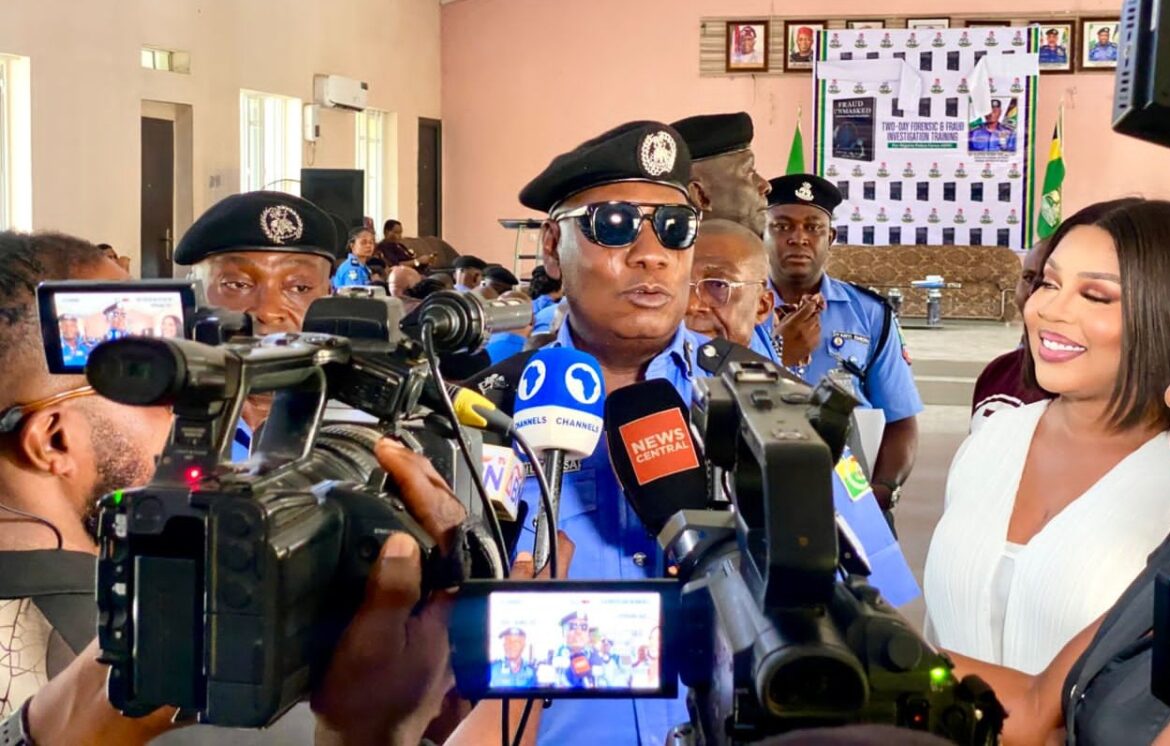
The Commissioner of Police in Abia State, CP Danladi Isa, has charged police officers to embrace scientific and intelligence-led methods in criminal investigations to ensure successful prosecution of cases in court.
CP Isa gave the charge on Wednesday at Police Officers Mess Umuahia while declaring open a two-day Forensic and Fraud Investigation Training for officers of the Nigeria Police Force.
He described the training as a major step toward improving professionalism, efficiency and effectiveness in policing, noting that modern policing requires evidence-based and technology-driven investigative procedures.
According to him, investigators must understand the elements of every offence and gather credible evidence before arraigning suspects in court.
“Policing is scientific. Investigation must be based on hypotheses, observations, findings and conclusions. The era of random investigations is gone. Policing is now intelligence-led,” he said.
The police commissioner thanked the Inspector-General of Police for choosing Abia State for the training programme, adding that training and retraining remain critical to the ongoing reforms within the Nigeria Police Force.
He said the programme would help officers become more competent and diligent in handling investigations, especially in fraud and forensic-related cases.
“So this fraud and forensic training is meant to move you from the level you were to a higher level, to make you more competent and diligent so that cases will not fail in court,” he stated.
Also speaking, former member of the House of Representatives, Barrister Uzoma Abonta, urged officers to remain professional and comply with legal procedures while carrying out investigations and arrests.
Abonta stressed the importance of respecting human rights and adhering strictly to provisions of the Police Act 2020, the Administration of Criminal Justice Act (ACJA), and the Anti-Torture Act.
He noted that modern criminals now operate digitally, making it necessary for investigators to adopt digital and technological tools in crime detection and evidence gathering.
“The law now permits the use of digital means in investigations because criminals are going digital,” he said.
He warned against unlawful arrests, torture, detention beyond constitutional limits, and arresting relatives of suspects in place of actual offenders.
According to him, suspects must always be informed of the reasons for their arrest and their rights, including the right to remain silent and access legal representation.
“Police can arrest without a warrant in certain situations, especially where a crime is committed in their presence or there is reasonable suspicion. But officers must still follow due process,” he explained.
Abonta also emphasized the importance of documenting recovered items during searches, recording statements properly, and using audio-visual technology during interrogations, as allowed by law.
He identified inadequate funding, poor equipment and centralized approval processes as major challenges affecting effective policing and modern investigations across the country.
Speaking at the event, Coordinator of the training, Dr. Pearl Chidinma Ogbulu, said the programme was designed to strengthen evidence-based policing, cybercrime investigation capabilities and professional investigative standards.
She encouraged participants to approach the training with discipline, professionalism and commitment to excellence.
“The era of outdated investigative methods is gradually giving way to scientific, technology-driven and intelligence-based policing,” she said.
Dr. Ogbulu also commended CP Danladi Isa for his support and commitment toward officer development and operational excellence in Abia State.
She expressed confidence that the training would help produce highly skilled forensic investigators capable of meeting global policing standards.
Our correspondent reports that Professor Suleiman Aruwa also gave a lecture during the training.